Discover Refractive Lens Exchange in Philadelphia
Tired of relying on reading glasses, dealing with blurry vision, or constantly reaching for multiple pairs of eyewear?
Refractive lens exchange offers a personalized way to take back control of your vision. By replacing the eye’s natural lens with a customized artificial lens, this procedure can address nearsightedness, farsightedness, astigmatism, and age‑related reading blur. For patients in Philadelphia who are not ideal candidates for laser vision correction, RLE may provide greater day‑to‑day freedom while also helping prevent cataracts in the future. At LASIK Experts, we can help you find the best option for your needs.

What Is Refractive Lens Exchange?
Lens replacement surgery works differently from LASIK or PRK. Instead of reshaping the cornea, the surgeon replaces the natural lens inside the eye with an intraocular lens (IOL). This makes refractive lens exchange surgery a strong option for patients over 45, people with high prescriptions, and patients with presbyopia who want clear distance and near vision.
How Does the Surgery Work?

Your eyes are mapped, dilated, and numbed with drops.

Through a tiny incision, the natural lens is removed using ultrasound.

A foldable IOL is placed inside the eye. The procedure takes about 10‑15 minutes per eye, and most patients recover quickly.
Which Lens Options Are Available?
Monofocal lenses
Usually set for distance vision. Reading glasses may still be needed.
Toric lenses
Help correct astigmatism.
Extended depth‑of‑focus lenses
Expand the range of vision with fewer visual side effects for some patients.
Multifocal or trifocal lenses
Options like PanOptix or Tecnis can improve near, intermediate, and distance vision to reduce dependence on glasses.
Find Out if You’re a Candidate for RLE
Book your consultation to see if RLE may be right for you.
Benefits and Outcomes of RLE

Who Is a Good Candidate?
- Typically 45+ years old
- Stable vision
- Interested in reducing dependence on glasses
- Healthy eyes overall
- May be a better fit than laser vision correction for patients with:
- Thin corneas
- High refractive error
- Early lens changes
"Dr. Chirag Shah and his team changed my life. I was not a candidate for Lasik due to my prescription being so bad. I thought I was going to be stuck with thick glasses for the rest of my life until they told me about the Refractive Lens Exchange surgery. I had the procedure done and could already read texts and emails without glasses the next morning. My vision transformation is amazing; I am so thankful that I found Dr. Shah and highly recommend him to anyone looking to improve their vision."
- Sarah Eberz

How Much Does RLE Cost?
The cost of lens replacement surgery depends on your prescription, testing, and lens technology. Premium lenses that correct astigmatism or provide a wider range of vision usually cost more than standard options, so an online intraocular lens price list cannot replace a personalized consultation.
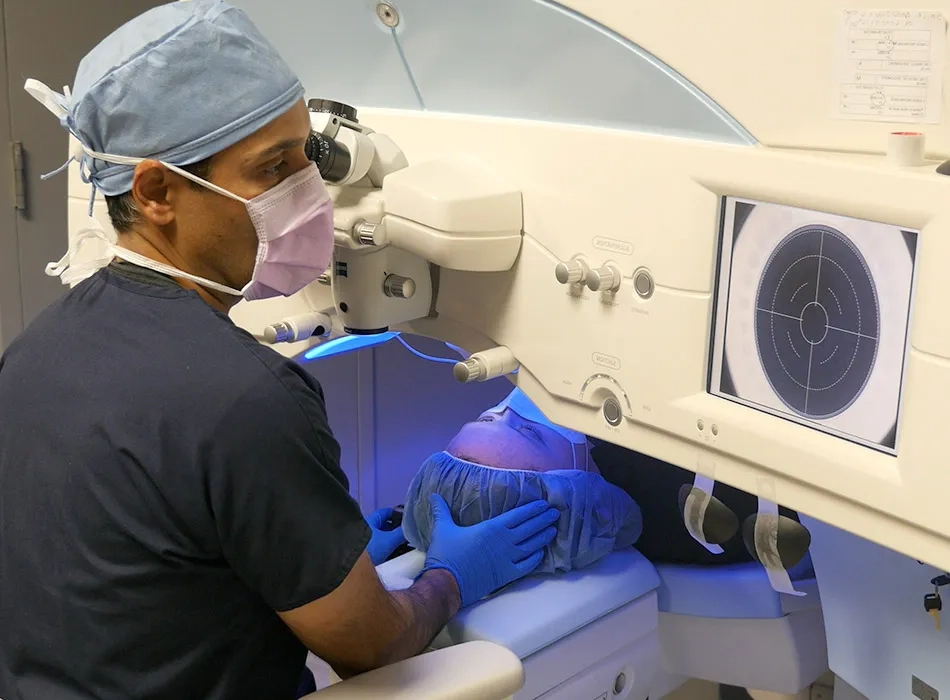
Experienced Care from Dr. Shah
Dr. Chirag Shah is a board‑certified ophthalmologist specializing in corneal and refractive surgery. Over the past two decades, he has performed more than 70,000 vision correction procedures. He also serves as a teaching and attending physician at Wills Eye Hospital, bringing deep experience and a personalized approach to patient care.
FAQ
Is RLE painful?
No. Numbing drops are used, and patients typically feel pressure rather than pain.
What are the risks?
The risks can include temporary dryness, glare or halos at night, mild residual prescription, infection, inflammation, or retinal complications. Serious complications are uncommon, but a consultation and exam are essential to confirm safety.
Will I still need glasses?
Some patients do, especially for fine print or certain nighttime tasks, but many reduce their dependence significantly.
How long is recovery?
Most patients resume routine activities within a day, with vision continuing to sharpen over the following days.
I searched for an oculoplastic surgeon in Philadelphia. Is that the same specialist for RLE?
No. Lens exchange surgery is performed by an ophthalmic surgeon with refractive and cataract expertise, not by an oculoplastic surgeon in Philadelphia.
Will I develop a cataract?
No. Because RLE replaces the eye’s natural lens, you will not develop a cataract in that lens later on. If anything, RLE may prevent the development of cataracts in the future.
What is the cost of RLE?
RLE typically ranges from $4,000 to $5,000. Your exact cost may vary based on the lens selected and your personalized treatment plan.
Which lens will you choose for my procedure?
Your surgeon will recommend the lens that best fits your prescription, eye health, lifestyle, and visual goals. Options may include monofocal, toric, extended depth-of-focus, or multifocal/trifocal lenses, depending on your needs.
Imagine reading, working, and enjoying daily life with less dependence on readers.
Refractive lens exchange may help you see more clearly at near, intermediate, and far distances. Find out if you're a candidate for Refractive Lens Exchange.